EC 270 - 2026-09-15 - Class - Ch. 02 - Budget Constraint
EC 270 - Tue Sep 15, 2026 - Lecture 02
Week 2 · 11:30 a.m.-12:50 p.m. · LH 1011 · Logan McLeod · Ch. 02 - Budget Constraint
Auto notes land here once transcribed: EC 270 - 2026-09-15 - Lecture 02
Before class
In class
- Consumer theory about understanding individual's choices
- Economists assume consumers make choices about the best bundle of goods they value and can afford
Building a model on the budget constraint
- Consumption choice set: collection all consumption choices there are
- If there are
different consumption goods to choose from: - Consumption Bundle =
- Consumption Bundle =
- There are lots of constraints for consumption choice like budget time, etc. but we focus solely on the price constraint
- For each commodity
, there is a price ( ) associated with it - Prices =
- Prices =
We assume consumers have income
- Expenditures <= (disposable) income:
Budget constraint: is formed by the consumption bundles that are only just affordable
if all items in the consumption bundle are
- The budget constraint is the upper bound
WE WILL BE LOOKING AT THE TWO-GOOD APPROACH
- It's very general
- Often, x_2 represents "everything else" which makes our model simpler and still allows us to develop theory
- Composite goods are a collection of goods (often, everything else)
Graphically
- m/p_2 is the vertical intercept and is the amount of goods if we bought only good 2
- m/p_1 is the horizontal intercept and is the amount of goods if we bought only good 1
- Any point along the budget constraint is "just affordable"
Properties of the Budget Set
- Vertical intercept:
- Horizontal intercept:
- Slope:
- The slope tells us how much of
I can exchange in the market to get one more unit of - Opportunity cost: the next best alternative forgone and in this case, the slope of the budget line measures the opportunity cost of consuming
- OC of an extra unit of
is of
- OC of an extra unit of
- The slope tells us how much of
Changes in Income
- If
increases, then the entire budget line shifts outwards/up in a parallel manner and are able to afford more - Remember, the slope of the budget line is
, and thus income changes (holding prices constant) shift the budget line either in or out in a PARALEL manner
- Remember, the slope of the budget line is
- Vice versa for decrease
Changes in Price
- What happens if
increases? - Doesn't affect the vertical intercept because the price of good 1 doesn't affect it. By definition,
is set to 0 - You can afford less of good 1, thus your budget constraint is reduced and your horizontal intercept is lower and thus the slope gets steeper.
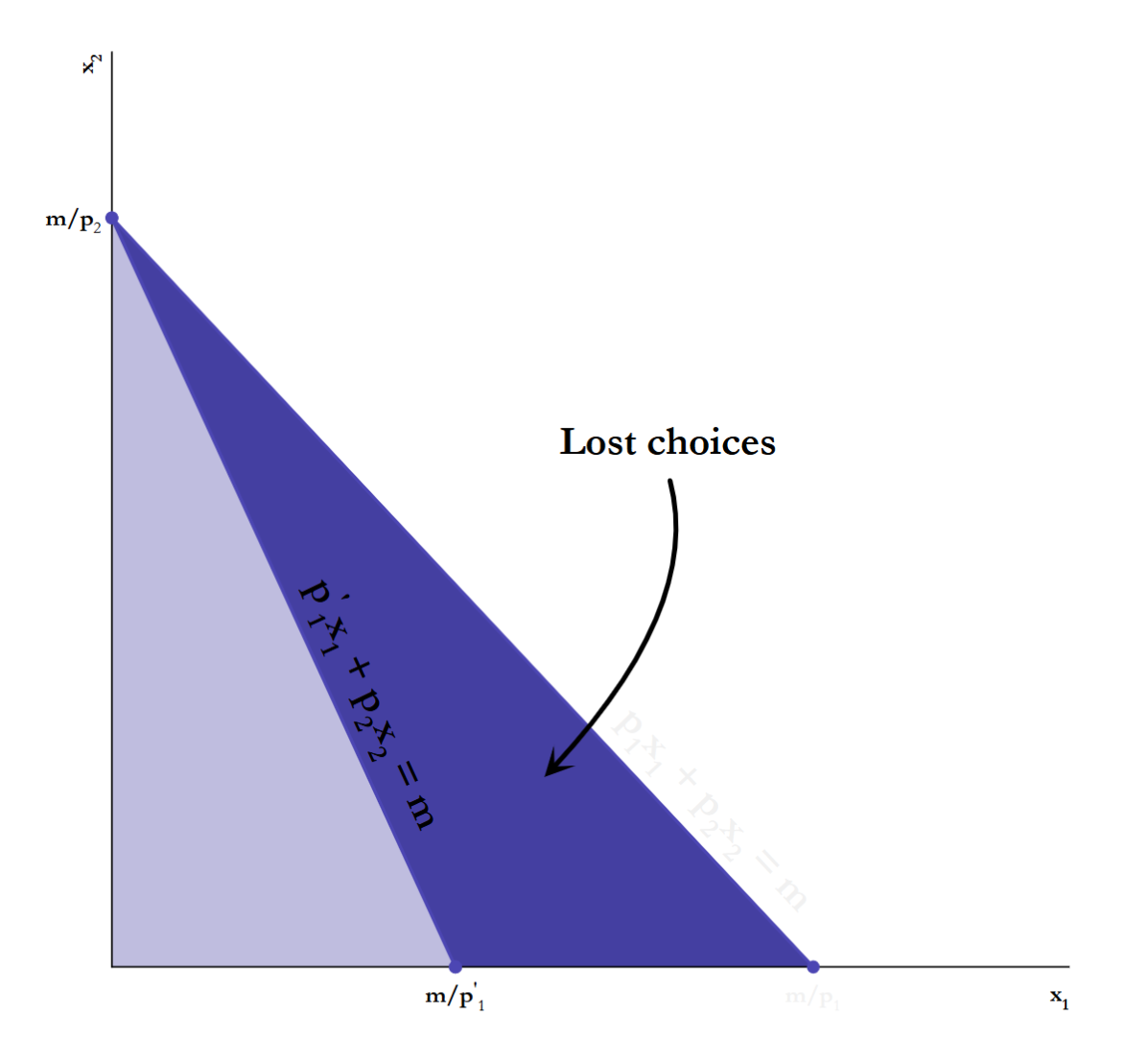
- Doesn't affect the vertical intercept because the price of good 1 doesn't affect it. By definition,
- Vice versa
The Numeraire
- Means "Unit of account"
- CHANGING THE NUMERAIRE DOES NOT AFFECT THE BUDGET LINE OR BUDGET SET
- We could peg one o the prices, or the income to some fixed value
or
Numeraire price: The price relative to which we are measuring the other price and income
Numeraire good: The good used to measure the value of other goods
Ad Valorem Sales Taxes
- It is a tax on the value of goods (e.g. HST)
- Harmonized Sales Tax (HST) is a 13% ad valour tax -> increases price from p to (1 + 0.13)p = 1.13p
- Assume the Ad Valorem tax is applied uniformly to all goods
- If the ad valour tax rate is
Then we have:
or
- This causes a shift inwards
Quantity Tax
- Consumer has to pay a certain amount to the government for each unit of the good they purchase
- Changes the price of good from
to
- Changes the price of good from
Lump sum Tax
- Consumers must pay a fixed amount of money, regardless of their behavior
Subsidies: "negative" taxes - Taxes increase the price to the consumer
- Subsidies decrease the price to the consumer
What if prices are non-linear?
- e.g. bulk buying discounts, price penalties for buying "too much"
- You have to adapt your slope depending on what x is
- How do you find your x-intercept though? You look at how much you've already spent on good 1 and then add whatever is remaining