Chapter 12 - Notes
12.1 - Measuring Inflation
Key Definitions
- Inflation: a generalized rise in the overall level of prices / a rise in the cost of living / a decline in the purchasing power of money
- Consumer Price Index (CPI): an index that tracks the average price consumers pay over time for a representative basket of goods and services
- Inflation rate: the annual percentage increase in the average price level, calculated as the percentage change in the price of a fixed basket of goods and services
- Deflation: a generalized decrease in the overall price level
How the CPI is Constructed (4 Steps)
- Find out what people typically buy
- Statistics Canada surveys thousands of people on their spending habits
- Most money goes to housing, transportation, and food
- Collect prices from stores where people shop
- Government surveyors visit thousands of retailers, check online stores, call offices, etc.
- Tally up the price of the basket
- Not a simple average — items you buy more of get more weight (e.g., coffee weighted more than tea if people buy more coffee)
- Set so the basket costs $100 in a base year, then tracked over time
- Calculate the inflation rate
Important Distinction
- Inflation (macro) = generalized rise in prices across the economy
- Relative price adjustment (micro) = price of individual goods rising or falling due to their own supply and demand
CPI Biases — Why CPI Overstates the True Cost of Living
- Quality improvements can hide price decreases
- Products get better over time but it's hard to fully adjust for that, so measured price increases partly reflect better quality, not true inflation
- New products make people better off
- CPI doesn't capture that a new invention (e.g., iPhone) replaced many expensive things — it only tracks price changes of existing goods, not the gains from new ones being invented
- Substitution bias: the overstating of inflation that occurs because people substitute toward goods and services whose prices rise by less
- CPI assumes a fixed basket, but in reality people swap expensive items for cheaper alternatives to maintain quality of life
- Together, these three biases overstate the cost of living by roughly 1% per year
- Statistics Canada tries to reduce this by updating the basket every ~2 years
12.2 - Different Measures of Inflation
Consumer Price Measures
- CPI — used for cost of living adjustments
- Workers use indexation clauses in contracts to automatically adjust wages in line with CPI
- Government indexes GST tax credits, payment amounts, and income cut-offs for programs based on CPI
- All-items CPI — what the Bank of Canada targets for monetary policy
- Target is to keep year-over-year CPI change close to 2%
- Core inflation — strips out temporary fluctuations to reveal the underlying inflation trend
- Private sector version excludes food and energy (not because they're unimportant, but because their prices are volatile and don't track broader trends)
- Yeah food and energy changes in price are not a good reflection because there are many other factors that affect those types of prices
- Bank of Canada uses its own core measures, like CPI-Median which tracks the 50th percentile of price changes in the CPI basket (it The median CPI is a measure of core inflation that calculates the price change of the item in the exact middle (50th percentile) of all component price changes, ranked from lowest to highest.)
- Private sector version excludes food and energy (not because they're unimportant, but because their prices are volatile and don't track broader trends)
Business Price Measures
- Producer Price Index (PPI): measures the price of inputs into the production process
- Useful for businesses to see how their costs are changing and to track competitors' costs
- Rising input prices eventually cause businesses to raise their prices for consumers
- GDP deflator: a price index based on a basket representing everything the Canadian economy produces
- Unlike CPI, it includes capital goods but excludes imported goods
- Used to convert nominal GDP into real GDP
- If the deflator is above 100 it means prices have risen since the base year, and nominal GDP will be greater than real GDP.
- If you're in the base year, the deflator is exactly 100 and nominal = real.
12.3 - Adjusting for the Effects of Inflation
Comparing Dollars Over Time
- You can't directly compare dollar amounts from different time periods because inflation changes the value of a dollar
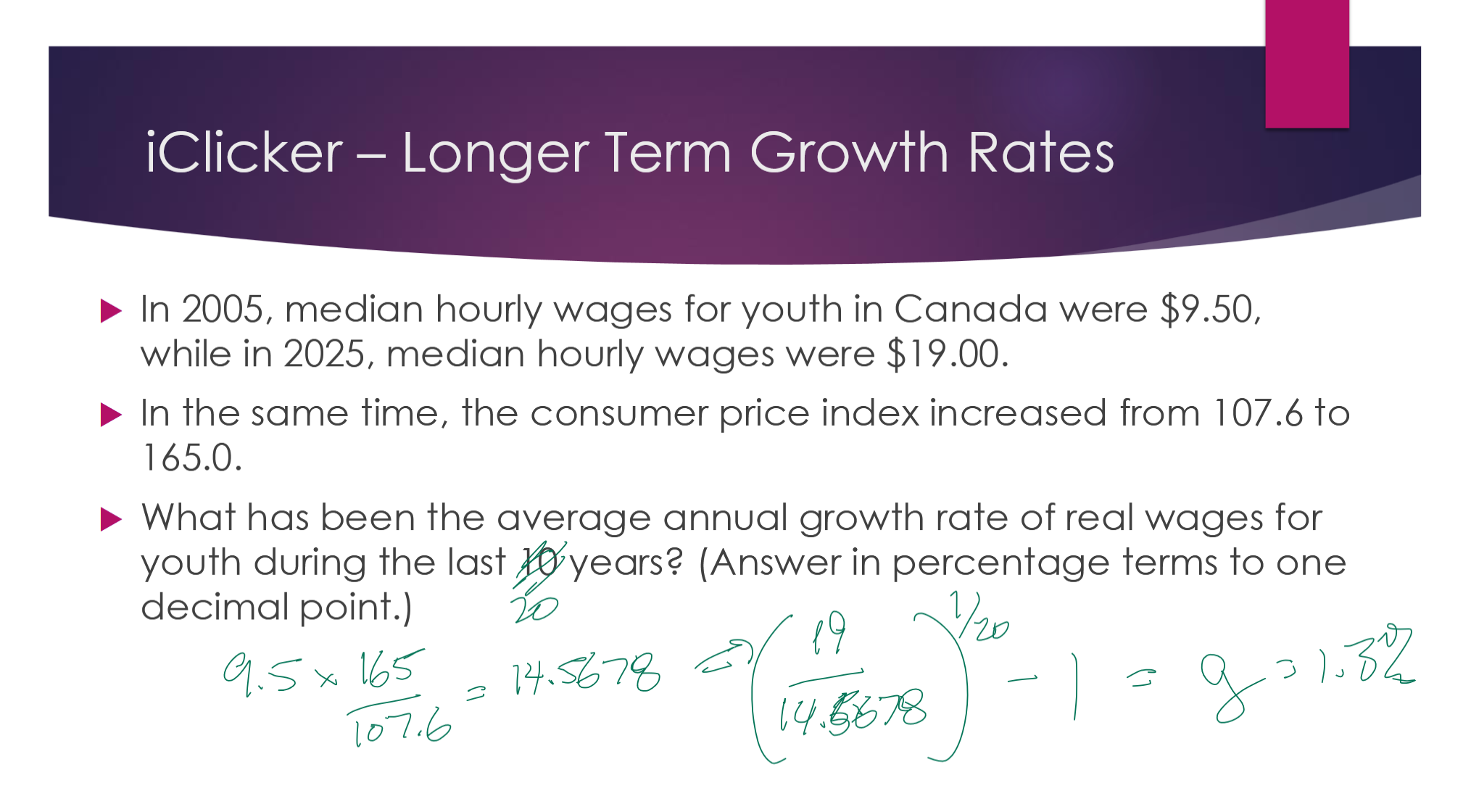
- Inflation adjustment formula:
- Can also adjust to any base year, not just "today" — just swap the numerator CPI to whatever year you want to convert into
Real vs Nominal Variables
- Nominal variable: measured in dollars whose values fluctuate over time — can change because of actual quantity changes OR because of inflation
- Real variable: adjusted to account for inflation — changes only in response to changes in physical quantities
- You should always focus on real variables when making comparisons over time
- Real wage > nominal wage for judging if you're better paid
- Real revenue > nominal revenue for judging business performance
- Shortcut: Real growth ≈ Nominal growth − Inflation rate (works for small percentage changes under ~10%)
Real and Nominal Interest Rates
- Nominal interest rate: the stated interest rate, no correction for inflation
- Real interest rate: adjusts for inflation, measures actual change in purchasing power
- Real interest rate ≈ Nominal interest rate − Inflation rate
- e.g., 5% nominal interest − 3% inflation = 2% real interest rate
Money illusion: the mistaken tendency to focus on nominal dollar amounts instead of real values
- Can distort decisions — e.g., if all prices AND your income rise by 25%, the real cost of everything is unchanged, but people still feel like things are more expensive
- Can lead to mis-pricing — e.g., selling a house based on what you paid years ago without adjusting for inflation
- Creates nominal wage rigidity — employers avoid cutting nominal wages because workers resent it, but with 2% inflation and 0% nominal raise, your real wage is actually falling by 2%
- In wage negotiations, always set your real wage as the baseline, not your nominal wage
12.4 - The Role of Money and the Costs of Inflation
The Functions of Money
- Money: any asset that's regularly used in transactions
Criteria:
- Medium of exchange — you use money to buy stuff and get paid for work
- Without money you'd need barter, which requires a double coincidence of wants (you need to find someone who has what you want AND wants what you have)
- Only works if people have faith that money will hold its value
- Unit of account — a common unit to measure economic value, compare prices, record debts, write contracts
- Needs to be stable to be useful (like how a measuring tape needs to stay the same length)
- Store of value — you can save money now and use it to buy stuff later
- Works when money is easy to store and holds its value over time
Inflation undermines all three functions — less reliable store of value, less stable unit of account, and in extreme cases people stop accepting it as a medium of exchange
Hyperinflation: an extremely high rate of inflation, think prices at least doubling every few months
- Venezuela example — café con leche went from 450 bolivars (2016) to 600 billion bolivars (2021)
- People resorted to barter, using US dollars, weighing cash instead of counting it
- Erodes all three functions of money completely
Costs of Expected Inflation
- Menu costs — costs businesses incur from having to update prices more frequently (reprinting menus, reprogramming vending machines, updating websites)
- Arises because inflation undermines money as a stable unit of account
- Shoe-leather costs — the time and effort people spend trying not to hold cash that's losing value (more trips to the bank, rushing to spend money quickly)
- Arises because inflation undermines money as a store of value
Costs of Unexpected Inflation
- Inflation confuses price signals
- Hard to tell if a price increase is real demand for that product or just general inflation
- Leads to mistakes — businesses might expand production unnecessarily or miss real demand increases
- Inflation redistributes between borrowers and lenders
- Higher than expected inflation = good for borrowers, bad for lenders (you repay in dollars that are worth less)
- Lower than expected inflation = good for lenders, bad for borrowers (you repay in dollars worth more than expected)
- Real interest rate = nominal rate − actual inflation, so if actual inflation differs from what was expected, one side wins and the other loses
The Inflation Fallacy: the mistaken belief that inflation destroys purchasing power
- Only tells half the story — yes prices go up, but wages and incomes typically rise in lockstep with inflation
- People blame inflation for higher prices but take personal credit for their higher wages
- Thought experiment: if every price AND every wage AND every bank balance all got an extra zero, nothing real changes — same purchasing power, same opportunity costs
- The costs of inflation aren't from the price level being higher, they're from the process of changing prices (menu costs, shoe-leather costs, confusion, redistribution)
NOTE: BITCOIN IS NOT A FORM OF MONEY IN CANADA
iClicker Questions:
- Unanticipated inflation is a gift to borrowers with fixed-rate debt
- Unemployment and output move in opposite directions:
- Unemployment below natural rate → output above potential → inflationary gap
- Unemployment above natural rate → output below potential → recessionary gap
- Unemployment equal to natural rate → output equal to potential → no gap