Chapter 16 - Notes
16.1 - International Trade and Global Financial Flows
International Trade Basics
- Exports: goods and services produced domestically and purchased by foreign buyers
- Imports: goods and services produced in a foreign country and purchased by domestic buyers
- Net exports (trade balance) = exports − imports
- Positive net exports = trade surplus
- Negative net exports = trade deficit
- Trade is driven by comparative advantage — each country focuses on what it can produce at the lowest opportunity cost
Global Trade is Growing
- Globalization: the increasing global integration of economies, cultures, political institutions, and ideas
- Global exports rose from ~12% of global output in 1960 to ~30% in 2019
- Driven by: cheaper transport (cargo ships carry 100x more), cheaper air transport, modern computer networks enabling trade in services, and governments negotiating trade deals
Canada as a Trading Nation
- Imports and exports each represent about one-third of Canadian GDP — higher trade share than US, China, or Japan
- Top trading partner: United States at 63% of our trade (~8x more than second-place China)
- Major exports: petroleum, wood, agricultural products, manufactured goods (cars, planes), and services (~1/5 of exports including tech, business services, tourism)
- Over half of imports are intermediate goods (machines, car parts, chemicals) — imports and exports are closely linked through global supply chains
- e.g., car parts can cross the Canada-US border multiple times during assembly
Global Financial Flows
- Financial inflows: foreigners investing in Canada (money flows IN)
- Financial outflows: Canadians investing in other countries (money flows OUT)
Three Types of Financial Flows:
- Foreign direct investment: foreigners investing in physical assets in Canada (e.g., Honda building a plant in Ontario)
- Hires Canadian workers, but profits go back to foreign owners
- Portfolio investment: foreigners buying Canadian stocks or bonds
- Deposits and loans: foreigners lending money to Canadians or depositing in Canadian banks
- Financial inflows in 2019: ~$316 billion (~$8,500 per Canadian)
- Financial outflows in 2019: ~$265 billion (~$7,000 per Canadian)
- Average Canadian held over $105,000 in foreign assets in 2020
Financial Globalization
- Cross-border financial flows have risen sharply over the past 50 years
- Driven by: removal of capital controls (rules limiting money flow across borders), financial deregulation, institutional investors diversifying internationally, technology making information faster, financial innovation
- Foreigners own a rising stock of assets in Canada, and Canadians own rising assets abroad
- Benefit: greater diversification reduces risk for everyone — a domestic downturn doesn't wipe you out if you're partly invested abroad
- Trade-off: disruptions in foreign markets (e.g., Japanese stock crash) now immediately affect Canadians too
16.2 - Exchange Rates
Key Definitions
- Nominal exchange rate: the price of a country's currency in terms of another country's currency
- e.g., if the exchange rate is ¥90 per Canadian dollar, you can buy ¥90 with C$1
The Nominal Exchange Rate Formula (Three Uses)
- Defines the exchange rate: Foreign currency = Exchange rate × Canadian dollars
- Convert dollars into foreign currency: Foreign currency amount = Exchange rate × Dollar amount
- e.g., C$4 pork at ¥90/C$ → ¥90 × 4 = ¥360
- Convert foreign currency into dollars: Dollar amount = Foreign currency amount / Exchange rate
- e.g., ¥270 at ¥90/C$ → 270 / 90 = C$3
- Works for any currency — just swap "yen" for "euro," "peso," etc.
- Watch out: make sure you know whether the exchange rate is telling you the price of a dollar (measured in foreign currency) or the price of the foreign currency (measured in dollars) — getting it backwards is a costly mistake
Appreciation and Depreciation
- Appreciation of the dollar: the price of a dollar goes UP (you get more foreign currency per dollar)
- Also called: stronger dollar, higher exchange rate
- Depreciation of the dollar: the price of a dollar goes DOWN (you get less foreign currency per dollar)
- Also called: weaker dollar, lower exchange rate
- When the dollar appreciates, the other currency depreciates (and vice versa) — they always move in opposite directions
Effects on Trade — THIS IS CRITICAL:
| Dollar Appreciates (stronger) | Dollar Depreciates (weaker) | |
|---|---|---|
| Imports | Cheaper in C$ (good for importers) | More expensive in C$ (bad for importers) |
| Exports | More expensive for foreign buyers (bad for exporters) | Cheaper for foreign buyers (good for exporters) |
- Appreciation example: a ¥48,000 Nikon camera costs C$600 at ¥80/C, but only C$400 at ¥120/C → imports got cheaper
- Appreciation example: C$4 pork costs ¥320 at ¥80/C,but¥480at¥120/C, but ¥480 at ¥120/C ,but¥480at¥120/C → exports got more expensive for Japanese buyers
Memory trick: appreciation is good for buyers of foreign stuff (importers), depreciation is good for sellers to foreign markets (exporters)
Canadian Effective Exchange Rate
- Since the dollar trades against many currencies simultaneously, economists created a single index: the Canadian Effective Exchange Rate
- Averages 17 exchange rates, weighted by each country's importance as a trading partner
- Tells you whether the dollar has appreciated or depreciated overall
Practical Tip: Currency Dealer Spreads
- When exchanging money (e.g., for vacation), the spread is the difference between the buy and sell price the dealer offers
- Smaller spread = better deal for you —> shop around
16.3 - Supply and Demand of Currencies
The Foreign Exchange Market Setup
- Foreign exchange market: where currencies are bought and sold
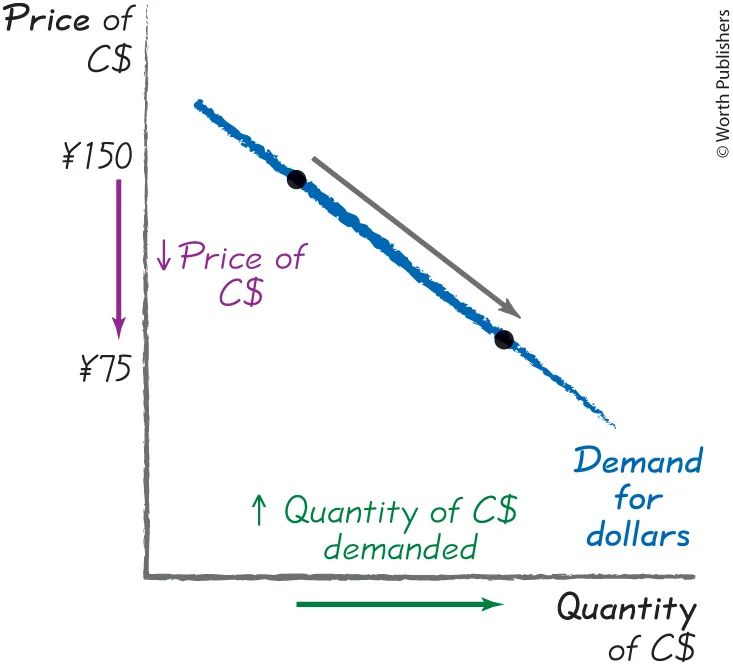
- Works like any other supply and demand market — price is the exchange rate, quantity is the number of dollars exchanged
- Two types of international transactions drive this market: trade flows (exports/imports) and financial flows (inflows/outflows)
Who Demands and Supplies Canadian Dollars?
- Demand for C$: foreigners who need Canadian dollars to buy Canadian exports OR invest in Canada (financial inflows)
- Supply of C$: Canadians who need foreign currency to buy imports OR invest abroad (financial outflows)
- Demand curve is downward-sloping: lower price of C$ → Canadian goods cheaper for foreigners → more exports → more dollars demanded
- Supply curve is upward-sloping: higher price of C$ → foreign goods cheaper for Canadians → more imports → more dollars supplied
- Equilibrium where they cross determines the exchange rate
Important: a change in the exchange rate itself is a movement along the curves, NOT a shift
Demand Shifters (things that shift demand for C$)
Shifter 1: Exports from Canada — anything that increases exports shifts demand RIGHT (appreciation)
- Stronger global economy → foreigners have more income → buy more Canadian goods
- Lower barriers to foreign markets → easier for Canadian firms to sell abroad (e.g., Japan lowering tariffs on Canadian pork)
- Domestic innovation and marketing → Canadian products become more attractive to foreigners
- Higher foreign prices → foreigners switch to cheaper Canadian alternatives
- Lower domestic prices → Canadian goods become more competitive internationally
Shifter 2: Financial inflows into Canada — anything that increases inflows shifts demand RIGHT (appreciation)
- Higher Canadian interest rates relative to foreign rates → better returns in Canada → more foreign investment flows in
- Higher business profitability in Canada → more profitable investment opportunities attract foreign money
- Higher foreign political risk → Canada looks like a safe haven → money flows in
- Expected future appreciation of C$ → speculators rush to buy dollars now before they get more expensive
Supply Shifters (things that shift supply of C$)
Shifter 1: Imports into Canada — anything that increases imports shifts supply RIGHT (depreciation)
- Stronger Canadian economy → Canadians have more income → buy more imports
- Lower trade barriers protecting domestic producers → cheaper/easier to import
- Foreign innovation and marketing → foreign products become more attractive
- Higher domestic prices → Canadians switch from domestic goods to imports
- Lower foreign prices → imports become cheaper → Canadians buy more
Shifter 2: Financial outflows from Canada — anything that increases outflows shifts supply RIGHT (depreciation)
- Lower Canadian interest rates relative to foreign rates → Canadians seek better returns abroad
- Lower business profitability in Canada → less reason to invest domestically
- Lower foreign political risk → safer to invest abroad
- Expected future depreciation of C$ → speculators rush to sell dollars now before they lose value
Key Insight: Financial Flow Shifters Are Mirror Images
- Almost any factor that increases financial outflows (supply shifts right) also decreases financial inflows (demand shifts left) — and vice versa
- These effects reinforce each other: e.g., if Canadian interest rates fall → outflows increase (supply right) AND inflows decrease (demand left) → both push toward depreciation
Three-Step Recipe for Forecasting Exchange Rates
- Does this affect demand (exports/financial inflows) or supply (imports/financial outflows) — or both?
- Does the curve shift right (increase) or left (decrease)?
- What happens to the exchange rate in the new equilibrium?
Practice Scenarios:
- "Buy Canadian" campaign → less imports → supply shifts left → C$ appreciates
- Germany puts tariff on Canadian cars → less exports → demand shifts left → C$ depreciates
- Chinese companies buy more Bombardier jets → more exports → demand shifts right → C$ appreciates
- Strong Canadian economy → more imports → supply shifts right → C$ depreciates
- Bank of Canada raises rates → more inflows + less outflows → demand right + supply left → C$ appreciates
- Political turmoil in Canada → more outflows + less inflows → supply right + demand left → C$ depreciates
Exchange Rate Regimes
- Floating exchange rate: determined purely by supply and demand — most countries today, including Canada since the 1970s
- Fixed exchange rate: government sets the price and buys/sells currency to maintain it (e.g., Canada 1962-1970 at US$0.925, the "Diefenbuck")
- Managed exchange rate ("dirty float"): mostly floating but central bank intervenes to limit big swings (e.g., Canada 1950-1960)
16.4 - The Real Exchange Rate and Net Exports
Key Definition
- Real exchange rate: the ratio of domestic prices to foreign prices, measured in the same currency
- Measures the international competitiveness of Canadian products (or more precisely, international uncompetitiveness — higher = less competitive)
The Real Exchange Rate Formula
Real exchange rate = Domestic price / (Foreign price / Nominal exchange rate)
- The denominator converts the foreign price into Canadian dollars so you can compare apples to apples
- e.g., Canadian pork = C$4/kg, Japanese pork = ¥450/kg, exchange rate = ¥90/C$
- Real exchange rate = C$4 / (¥450 / 90) = C$4 / C$5 = 4/5
- Meaning: Canadian pork costs 4/5 the price of Japanese pork → Canada is competitive
What the Real Exchange Rate Tells You
- Low real exchange rate = Canadian goods are cheap relative to foreign rivals = more competitive
- High real exchange rate = Canadian goods are expensive relative to foreign rivals = less competitive
- Two interpretations:
- A price comparison: how cheap/expensive domestic goods are vs foreign goods
- An exchange rate for real stuff: the rate at which you can swap one country's output for another's (vs. nominal exchange rate which swaps currencies)
How the Real Exchange Rate Affects Trade
Real depreciation (real exchange rate falls → Canadian goods become relatively cheaper):
- Imports decrease — Canadians switch to cheaper domestic goods
- Exports increase — foreigners switch to cheaper Canadian goods
- Net exports rise
Real appreciation (real exchange rate rises → Canadian goods become relatively more expensive):
- Imports increase — Canadians switch to cheaper foreign goods
- Exports decrease — foreigners switch away from expensive Canadian goods
- Net exports fall
Three Things That Can Change the Real Exchange Rate
- Domestic prices change (Canadian inflation)
- Foreign prices change (foreign inflation)
- Nominal exchange rate changes (currency appreciation/depreciation)
- Any of these can make Canadian goods relatively cheaper or more expensive
Economy-Wide Real Exchange Rate
- Compares CPI across countries, adjusted for the nominal exchange rate
- Trade-weighted real exchange rate (Canadian Effective Exchange Rate): compares Canada's competitiveness against a weighted average of our 17 biggest trading partners
- This broad measure is a key driver of net exports — movements in the real exchange rate predict changes in net exports well
16.5 - The Balance of Payments
Two Accounts That Track International Transactions
1. Current Account
- Tracks income flows into and out of a country
- Income IN: exports + investment income Canadians earn on foreign assets + other income from abroad
- Income OUT: imports + investment income foreigners earn on Canadian assets + other payments abroad
- Current account balance = income received from abroad − income paid abroad
- Broader than net exports — includes investment income, not just trade
- Canada ran a ~$50 billion current account deficit in 2019 (paid more to foreigners than received)
2. Financial Account
- Tracks changes in ownership of assets across borders
- Financial account balance = financial inflows − financial outflows
- Canada ran a ~$50 billion financial account surplus in 2019 (foreigners invested more in Canada than Canadians invested abroad)
- Does NOT count as income — selling $10,000 of stock to a foreigner is just swapping one asset for another, no new income created
The Critical Rule: Current account deficit = Financial account surplus (ALWAYS)
- Every dollar spent overseas eventually returns to Canada — either spent on Canadian exports or invested in Canadian assets
- Inflows of dollars must equal outflows of dollars
- Current account describes the uses of cash, financial account describes the sources
Saving, Investment, and the Current Account
Current account deficit = Total spending − Total income
- Canada has a deficit when we spend more than we earn → need foreign funds to cover the gap
Current account deficit = Investment − National saving (I − S)
- National saving = personal saving (income − consumption − taxes) + government saving (taxes − government spending)
- A deficit arises because investment exceeds what we save domestically
- The gap is funded by foreign savings (financial inflows)
Investment = National saving + Financial account surplus
- All investment must be funded somehow: either from domestic saving or from foreign savings flowing in
- Financial inflows from abroad are useful because they help fund investment that domestic savings alone can't cover
Is a Current Account Deficit Good or Bad?
Bad interpretation:
- Canadians living beyond their means, selling assets and borrowing from foreigners
- Risk of a sudden stop: foreign investors lose confidence and abruptly stop lending → economy tanks
- More common in developing countries but consequences are severe
Good interpretation:
- The flip side is a financial account surplus → more foreign investment → more loanable funds → more investment in Canada
- If that investment is high-quality and boosts future income, spending more than you earn now is smart
- Reducing the deficit could actually hurt by preventing valuable investments
Bottom line: depends on whether the underlying spending decisions are sound — could be a sign of trouble OR a sign of economic strength
Don't worry about bilateral trade balances
- Having a trade deficit with one specific country (e.g., China) is irrelevant — what matters is whether ALL of Canada's international transactions together are sustainable
- "I have a chronic deficit with my barber, who doesn't buy a darned thing from me"