Chapter 11 - Notes
11.1 - Unemployment and Employment
- Working age population: people aged 15 or older (excluding those in Canadian Armed Force or institutionalized - those who live in a nursing home, mental health residential facility or prison)
- Those who work at least one hour during the week for pay of some kind, then they are considered employed
- Also considered are people who have jobs but are temporarily absent
- Unemployed are people in the working-age population without jobs but who are trying to get jobs
- Criteria:
- Part of working-age population
- Not currently working
- Actively searching for work
- Able to accept a job if it were offered
- Criteria:
- Labour force is employed plus unemployed
- Not in the labour force: If you're in the working-age population but you're neither employed or unemployed - that could be in school, retired, taking care of another family member
- Labour force participation rate: $$\text{Labour force participation rate} = \frac{\text{Employed + Unemployed}}{\text{Working-age Population}}\times 100$$
- Labour force participation rate differs between men and women
- Unemployment rate: $$\text{Unemployment rate} = \frac{\text{Unemployed}}{\text{Labour force}}\times 100$$$$\text{Unemployment rate} = \frac{\text{Participation Rate} - \text{Employment Rate}}{\text{Participation Rate}}$$
- Unemployment rate is never zero and fluctuates.
- When economy grows, unemployment rate tends to fall
- When economy slows down, unemployment rate tends to rise
- Equilibrium unemployment rate is the long-run unemployment rate to which the economy tends to return
- Long term unemployment: When someone spends more than six consecutive months unemployment
- May lose skills which makes it even harder to find employment
11.2 - The Dynamics of the Labour Market
- Discouraged searchers: People who want to work but are not currently searching
- There are also people who are considered "waiting"
- Underemployed: People who want a full-time job but aren't getting the full-time hours or if the job you're getting isn't adequately using your skills
- Involuntary part time: If you have a part-time job but want a full-time position.
11.3 - Understanding Unemployment
Types of Unemployment
- Frictional Unemployment
- Unemployment due to the time it takes for employers to search for workers and for workers to search for jobs
- Even if labour supply equals labour demand, the matching of workers to employers isn't instantaneous
- Structural Unemployment
- Unemployment because wages don't fall to bring labour demand and supply into equilibrium
- Since wages are higher than equilibrium, more people want to work, but employers off fewer jobs
- Things that lead to this are unions, government policies
- Cyclical Unemployment
- Unemployment due to a temporary downturn in the economy
- Explains why unemployment rate rose during 2008-2009 recession and why it fell after the economy recovered
- Calculated by:
Frictional Unemployment Factors
- Efficiency of technology, networks and other resources that help workers find jobs
- The better workers are at identifying jobs best suited for them, the less time they spend looking for a job and thus lower the frictional unemployment
- Distribution of skills among workers compared to distribution of skills needed by employers
- The more diverse workers and jobs are, the more difficult it is for workers and employers to find the right match
- Mismatched skills or not adapting to new technologies also affects frictional unemployment
- Workers' access to financial support when they're looking for work
- EI can lead to a longer unemployment
Personal referrals help to find jobs
Structural Unemployment Factors
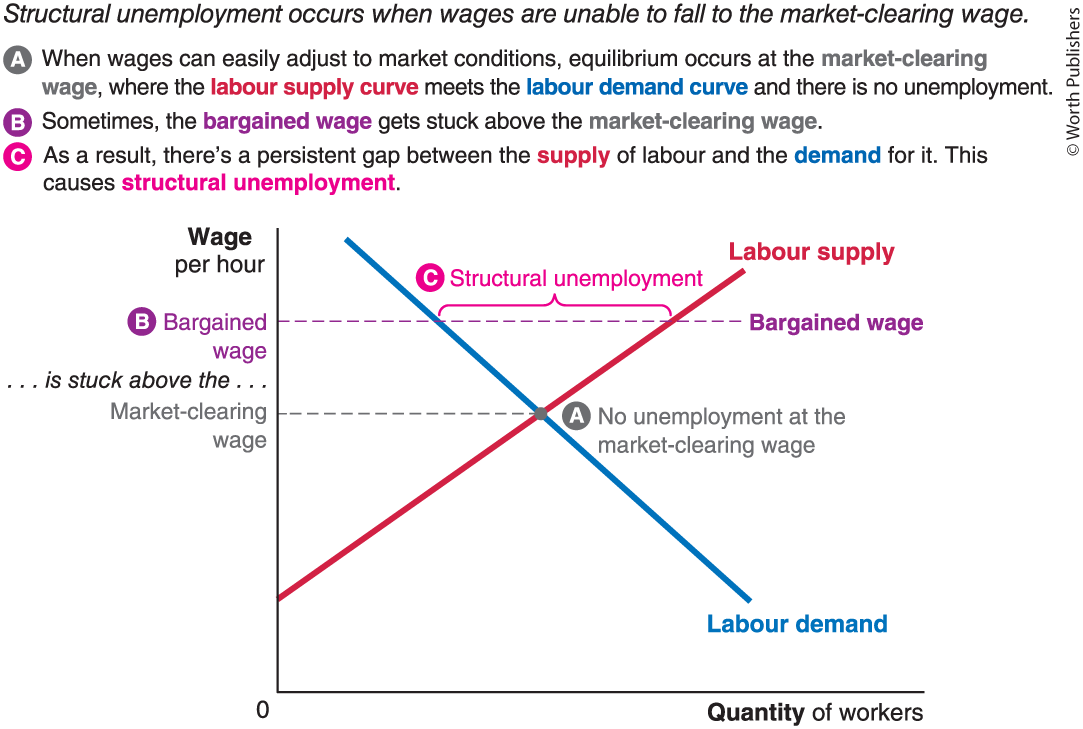
- Efficiency wages - when employers deliberately pay above the market wage
- Many workers want that job but there end up being more unemployed in the hopes they get that job
- Unions can keep wages high for some workers
- Job protection regulations make it hard to fire workers
- Makes employers more hesitant and causes employees to be more slack-off ish
- The minimum wage keeps wages from falling below the set minimum wage
- Usually affects teenagers
11.4 - The Cost of Unemployment
Economic Costs
- The unemployed often end up with lower wages and worse career opportunities even after finding work again
- Earnings loss is especially worse if they lost their job during a recession
- Men laid off during mass layoffs lose ~1.4 years of earnings when unemployment is low, but ~2.8 years when unemployment is high
- Permanent unemployment can arise from periods of high unemployment
- Workers lose skills, contacts, and hope — known as hysteresis: when a period of high unemployment leads to a permanently higher equilibrium unemployment rate
- Higher unemployment -> skills loss/discouragement -> higher equilibrium unemployment rate
- Even when the economy recovers and jobs are available, it still takes people longer to find them
- Workers lose skills, contacts, and hope — known as hysteresis: when a period of high unemployment leads to a permanently higher equilibrium unemployment rate
- High unemployment means government gets less tax revenue but has to spend more on the social safety net
Social Costs
- Unemployed people are sadder, more stressed, more likely to experience depression, anxiety, poverty, and divorce
- Long-term unemployment is associated with even worse outcomes
- Greater permanent earnings losses, more health problems
- Job loss nearly doubles chance of dying a year later, and death rates stay higher for decades
- Children of unemployed parents suffer too
- Worse academic outcomes, worse mental health, worse employment outcomes as adults
- Parent losing a job while child is in high school = child is less likely to go to college/university
Protecting Yourself from Unemployment
- Do more job searching than you want to — apply if marginal benefit of applying exceeds marginal cost
- Build up a nest egg (3-6 months of expenses saved)
- Keep building new skills so you stay adaptable
- Keep an eye out for better opportunities even while employed
- Tap into your networks and referrals if you become unemployed
- Avoid long-term unemployment — sometimes take the "not perfect" job and keep searching while employed