Let and be integers with , and let be numbers. We define
which we refer to as a sum expressed in .
The symbol "" is the capital Greek letter , which indicates addition. is the and varies through all integer values from to , as specified by the and below and above the sigma, respectively. The expression represents the term in the sum.
Remark!
Different letters can be used to represent the index of the summation. could be substituted for or , etc.
Example
(a)
(b)
(c)
(d)
Finite sums written in sigma notation obey all of the usual rules we know for addition. These properties are summarized below.
Theorem 0.1.3 - Properties of Sums
Let and be real numbers.
(i) For any ,
(ii)
(iii)
Example 0.1.4
If and , then what is the value of ?
Solution: We have
We can reindex sums as there is not a unique way to represent a sum.
Method 1 - Add and subtract terms
Example 0.1.5
By adding and subtracting terms, reindex the sum to start at . Solution: We have
We added 3 terms and then subtracted them to fix the index. As intuition might tell you, with large numbers this becomes ridiculous and thus we turn to our second method.
Method 2 - Adjust the index within the sum itself
Example 0.1.5
Reindex the sum to start at .
Solution: We subtract 99 from the starting and ending index to get and and then we add 99 to the i in the actual term. So,
0.2 Completing the Square
How to complete the square:
Consider the polynomial .
The goal is to add and subtract certain constant that will make part of the quadratic recognizable as a perfect square; hence the name "completing the square":
We divide the coefficient of the -term by and square the result. In this case, dividing by , we get , squaring we get . Replacing the blank box above with 9, we get:
So, we have:
Example 0.2.1
Rewrite by completing the square.
Solution: We take the coefficient of the -term, in this case . We divide by and square the result to get .
So,
There is one more thing we must keep in mind. You always want to factor out the -term from all terms that involve .
For example, consider the polynomial . Factoring the coefficient of from all terms involving , we get
We divide the coefficient () by and square the result to get . Since we factored out , we must multiply by when we subtract on the outside. This turns to be
Finalizing the steps, we get
Chapter 1 - Integration
The motivation is to compute the area between the graph of a function and the -axis over an interval [, ]. This leads us to the definition of the definite integral. Integrals are used to calculate volumes of 3D solids, the wok done in applying force to an object over some distance, probabilities and expected values, forces and stresses on structures, fluid flow and heat transfer, and much more.
1.1 The Definite Integral
1.1.1 Area Under a Curve
If we are trying to find the area under a line, it is simple. We can just break the graph into separate polygons. In this example, the area of is and the area of is and so the total area is
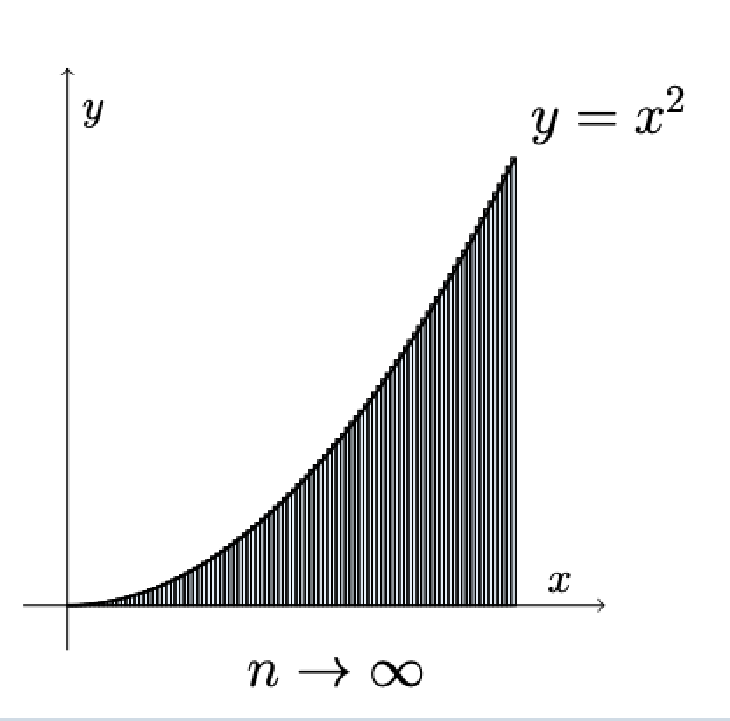
However, if we try to find the area under a curve like over [], it becomes much harder because we cannot use geometry.
Riemann Sum Motivation
Let where is the width of each rectangle.
And, is the number of intervals in the domain of [].
Therefore,
Overestimate
When the function is decreasing and we use left-point Riemann sums
DRAW A PICTURE
When the function is increasing and we use right-point Riemann sums
DRAW A PICTURE
Underestimate
When the function is decreasing and we use right-point Riemann sums
DRAW A PICTURE
When the function is increasing and we use left-point Riemann sums
DRAW A PICTURE
Unable to tell if over or under estimate
When we use the midpoint
DRAW A PICTURE
The big Idea
We want to increase the amount of subintervals () to the point that the width of each rectangle gets closer and closer to . At this rate, the left and right point Riemann sums almost don't even matter because they're basically the same point.
Definition - Regular Partition
Consider an interval [] with and let be a positive integer.
If we define , then points given by
separate [] into subintervals of equal width, :
Consider the function on the interval [, ]. We want to find the area between the curve and the -axis. If we divide the region into 4 rectangles of equal length