ECON 140W - Week 3
Class 5 - Jan. 20, 2026
Terminology
-
Numbers in brackets are for 15+ in Canada in December
-
Employed (21,056,400)
- Includes people on leave (employed but zero hours worked)
-
Unemployed (1,413,200)
-
Not in the labour force (12,253,300)
-
if you add 21,056,400 and 12,253,300, you get less than the population of Canada
- Why? We don't count people under 15 years old
-
Participation Rate (or activity rate)
- (Employed + Unemployed)
Total population
- (Employed + Unemployed)
-
Employment rate
- Employed
Total Population - Telling us about the long-run trend of environment
- Employed
-
Unemployment Rate
- Unemployed
Labour Force - Unemp
(Unemp + Emp) - If unemployment rate right now is 6%, that doesn't mean employment rate is 94%
- Unemployed
Seasonal Adjustments
- Measured unemployment rate in Canada went from 8.0% in August to 6.3% in December
- Commonly reported unemployment rate in Canada went from 7.1% in August to 6.8% in December
- Reported unemployment rates are adjusted for seasonality
- Unemployment rates always high in January, July, August due to hiring processess
- Unemployment rates always low in April, May, December
- Adjust reported rates for these differences when comparing within a year
Dynamics of the Labour Market
- Labour market flows
- People move between states (employed, unemployed, out of labour face)
- Changes in the unemployment rate can reflect variety of changes
- In recessions, some people may stop looking for jobs, so unemployment rate doesn't rise that much and in fact may go down
- Long-term unemployment is a significant problem
Other Employment Terminology
- R1 - 0.8% - is the fraction of the labour force who've been unemployed for longer than a year
- R2 - 2.7% - is the fraction of the labour force who've been unemployed for longer than 3 months
- R3 - compared to US rate (5.3%)
- Always higher than US because
- US starts counting at 16
- Main reason: The question of "Are you looking for work?" differs. In the US you have to apply for a job or go to a government employment center. Compared to Canada where you can say you scrolled on indeed and didn't find any job
- US has high prison population
- Always higher than US because
- R4 - Unemployment (6.3%) - official measure (not seasonally adjusted)
- R5 - Discouraged (0.2%) - available but not looking
- R6 - Waiting (0.5%) - Not working, but waiting for a job to start/restart
- If someone hires you in April but you don't start till August for example
- R7 - Involuntarily Part-Time (1.5%) - in full-time equivalents
- Would like to work more, available for more hours, but can't
- R8 - Include R5, R6, R7 (8.5%)
Types of Unemployment
- Frictional unemployment
- matching employers to employees takes time
- Always positive
- Structural unemployment - usually 2.5-3%
- Wages held above market clearing level
- Always positive
- Long-run unemployment is equal to frictional plus structural (estimates between 5.0% and 6.5%)
- Cyclical unemployment is the variation over the business cycle - usually 2-3% because of people moving between jobs
Frictional Unemployment
- Job search takes time
- Finding a good match, going through an application and interview process, etc.
- While this happens - people are enemployed
- Policies that impact frictional unemployment
- Employment insurance
- If you're getting good benefits, you're less likely to take a job - causes increase in frictional unemployment
- Job search, job training
- Since you get employment insurance, there will be better job matching because people will spend more time looking at the best position for them
- Employment insurance
Structural Unemployment
- When wages are higher than the equilibrium level
- Efficiency wages
- Paying a higher wage to make you more efficienct, so they higher a bit less
- Employers will often pay more than they absolutely have to because they don't want you to just leave
- Unions
- Job protection regulations
- Minimum wage laws
- Efficiency wages
Economic Costs of Unemployment
- Costs of unemployment depend on economic conditions
- Quality of job matches varies after unemployment
- Depends on unemployment rate
- Unemployment can lead to hysteresis
- Once unemployed, skills erode making it harder to find work
- A period of unemployment can lead to a higher equilibrium unemployment rate
- Long-term unemployment has longer-term consequences
- Government gave certain companies money to keep paying people to not work so that people don't just leave the industry with these specialized skills
Artificial Intelligence and Unemployment
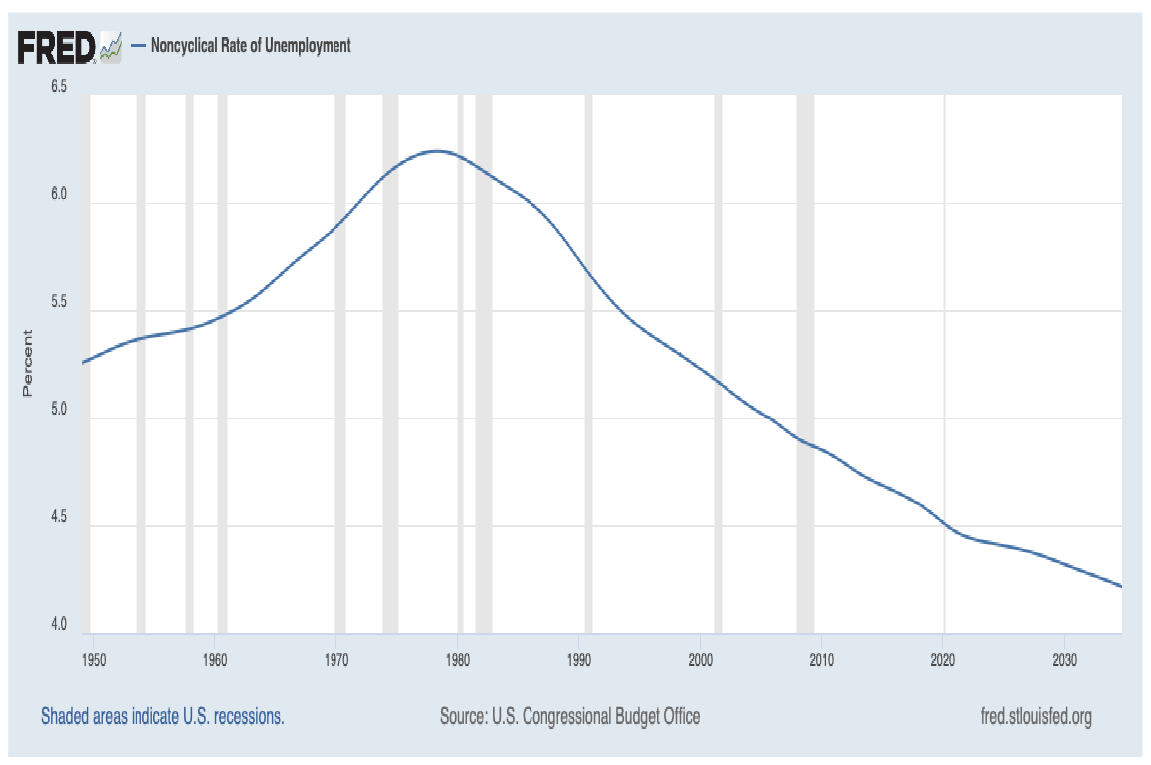
- Equilibrium (non-cyclical) unemployment also falling in the U.S.
- People talk about AI replacing jobs
- If you're automating something, somebody's job gets lost but another one is created
- There is not a fixed amount of jobs
- Not clear this is happening yet
Productivity
- What about wages?
- Labour productivity commonly measured as output per worker or ouput per hour worked
- Not the same as wages, but related
- From 1997 to 2025
- Average hourly wages increased from $15.59 to $36.40 (not adjusted for inflation)
- Average weekly wages increased from $573.50 to $1329.77
Class 6 - Jan. 22, 2026
- From province to province, participation rates and employment rates vary significantly!
Measuring Inflation
- Can be super easy and also super hard
- Identify a basket of goods people are going to buy
- How much will that cost?
- Measure it each year, and then another year, and then you find inflation
- Includes food, housing, electronics, rent, etc. basically everything that Canadians buy
- They track million of things people buy and measure the cost of the basket of all of it
- Must choose a base year (always 100), and you measure the prince index relative to the base year
- Currently, it's 2002
- Issues?
- We need to account for the change in quality for goods
- What exactly is in the basket of goods?
- For example, streaming services did not exist back then, it was really just cable
- How often do we change the goods that we're looking at?
- They use some chain-related thingy to adjust it but nobody ever does it unless you work for Statistics Canada
Measures of Inflation
- We measure multiple different types of inflation
- All-items CPI - reflects average purchases in Canada (literally everything we buy)
- Core inflation - throw out all the food and energy purchases - natural gas, food, energy
- We do this because the prices fluctuate a lot that is not due to the Canadian economy
- CPI-Median - tracks the 50th percentile of price changes
- Producer price index (PPI) - business inputs
- Raw materials
- This is a leading indicator of inflation (if these rise, they'll eventually raise prices)
- GDP deflator - prices of goods that Canada produces
- GDP deflator = (Nominal GDP
Real GDP) - Any good that we import and don't produce will affect the CPI but not GDP deflator
- Example: bananas, coffee, oranges, all kinds of food, semi conductors, sugar
- We produce more than we consume of: oil, wheat, lumber
- GDP deflator = (Nominal GDP
Core Inflation
- Common comparisons: CPI to GDP deflator or CPI versus Core Inflation
- Bank of Canada reports changes in core inflation
- Measure that excludes all food and energy prices
- They are highly traded commodities on the global scale
- Changes in these prices are almost entirely unrelated to Canadian economic conditions
- Bank of Canada prefers other measures (CPI-median)
- Key point - Bank of Canada using inflation measures for a specific purpose
Adjusting for Price Effects
- Use the prince index to adjust for price changes
- Nominal variables
- Measured in current prices
- If you go back to 1997, minimum wage was ~$7, but real minimum wage would say okay how much could $7, 28 years ago, buy today
- Real variables
- Mostly talk about real GDP, real interest rates, etc.
- Real equals nominal minus inflation (approximately)
- This is precisely true for interest rates
- Real interest rate reflects the change in buying power
Example:
This is less than today's $16.70.
- There's a problem with this statement though.
- CPI tracks everything, even things that regular Canadians don't buy
- For example, a boat
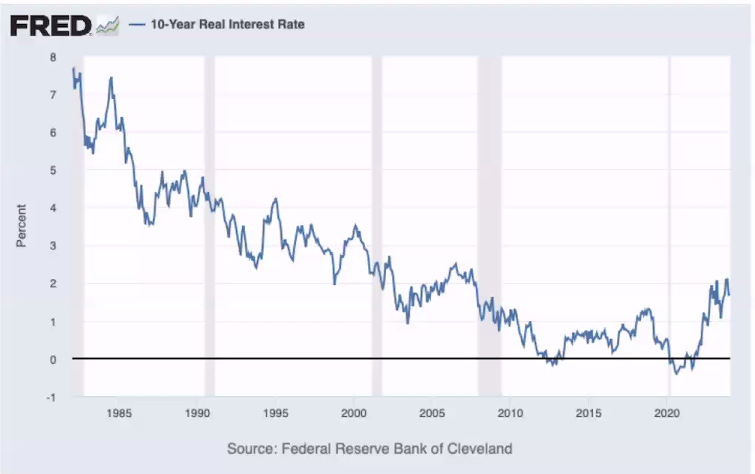
Real Interest Rates (US Data)
- Real interest rates fell since 1980
- Companies, people lend based on real interest rates, that's really all that matters
- Negative nominal interest rates are bad
- Real interest rates being negative is not necessarily bad
- Nominal interest rate minus expected inflation rates
- 7% interest implies doubling purchasing power in 10 years
- Rule of thumb (Rule of 70): $$\frac{70}{7} = 10$$
- Zero real interest rates recently
- Why have real interest rates fallen? Chapter 14 says it all
Average Wages for Youth in Canada
- Data from December 2024 to December 2025
- Inflation was 2.4%
- Youth (15-24) - average wage increase 2.3% (or -0.1% real increase)
- From $21.72 to $22.21
- Lower paid sectors (still focused on youth - 15-24)
- Wholesale and retail trade - from $18.80 to $18.54 (not good)
- Accommodation and food service - from $18.28 to $18.32
- Other sectors
- Finance, Insurance, Real Estate (FIRE) - from $25.69 to $27.74 (+8.0% nominal, +5.6% real)
- Not a huge group of people so varies often
- Finance, Insurance, Real Estate (FIRE) - from $25.69 to $27.74 (+8.0% nominal, +5.6% real)
Money Illusion and Nominal Wage Rigidity
- Money illusion
- Focusing on changes in nominal dollar amounts
- People get mad when they're nominal dollars go down
- Nominal wage rigidity
- People focus on nominal wages - no one likes a pay cut
- When cutting payroll costs, companies choose layoffs over pay cuts
- In recessions, unemployment rises instead of wages falling
- A key reason to target positive inflation (2%)
What is Money?
- Medium of exchange
- Can you buy things with it?
- Unit of account
- Do you record prices in that value?
- Do accountants record balance sheets and income statements
- Store of value
- Can you keep value in that product?
- Can you reliably keep assets in that value and know what they will purchase
- Is gold money? Is Bitcoin?
- BITCOIN IS NOT A UNIT OF ACCOUNT
- IT'S NOT A MEDIUM OF EXCHANGE
- The fact you can buy some things with it, doesn't mean it's a median exchange
- In Nicaragua, they made bitcoin an official currency
- This doesn't mean it's money though. In order to be considered money, it has to be generally accepted almost everywhere
- Is the US dollar money in Canada?
- It's a decent medium of exchange, almost everybody accepts it!
- Most grocery stores will accept it
- It's not really a unit of account though
Expected vs. Unexpected Inflation
- What was expected inflation in 2025? What was inflation in 2025?
- If there's unexpected inflation, that throws prices out of whack quickly!
- What inflation rate should you expect in 2026?
Costs of Inflation
- With expected inflation,
- "Menu" costs is more generally the decision process on what should we charge, "shoe-leather" costs
- With unexpected inflation,
- Prices convey less information, redistribution (lenders vs. borrowers)
- If you're gonna get $20/hour but don't know how much things will cost, you don't know what you can get
- Inflation is good for students that owe money on student loans
- If inflation happens during university, this is good because wages will then go up later
- Prices convey less information, redistribution (lenders vs. borrowers)