Chapter 2 - Claims - Notes
Intro
- VERY FIRST THING is to identify the author's claim, which is the major conclusion of a piece of writing the author is trying to persuade you to accept
- Sometimes in the title, very first paragraph, sometimes it's implicit and you have to decide what it is in your own words
- After the claim, the other statements will be evidence
- Be careful, be fair about implicit claims
Uncontested claims
- Critical thinking does not mean negative thinking
- We don't need to question EVERY claim and can take some as unproblematic
- Some conditions people may accept a claim:
- We usually don't contest claims that are consistent with our own experiences and observations, things that we have seen, heard, or touched
- The roads are congested with traffic between 4 and 6 p.m.
- I like the taste of black olives
- Golf is my favorite sport
- Some claims appear to be facts that are independent of interpretation. Events that happened are often not questioned
- Quebec is larger than Nova Scotia
- When we read a newsreport of a train accident
- Areas in which there is agreement among experts, or strongly supported general claims that are more common sense
- Knowledgeable and intelligent people are in general that you cannot physically be in two places at once
- Business scholars agree Frederick Taylor is known to be the father of modern management
- Technical or mathematical claims
- We don't question that debits equals credits in double-entry accounting
- We don't question a megabyte is 0.0009765625 of a gigabyte
- We usually don't contest claims that are consistent with our own experiences and observations, things that we have seen, heard, or touched
Contestable claims
- Example: Claims that people who have excelled in the academic world make poor entrepreneurs or that having a mandatory age decreases a country's productivity and economic progress
- Often introduce new ideas that awaken curiosity and cause people to think about things in new ways
- For one claim, many different people may have differing opinions
- The quality of the reasoning and evidence is what leads us to accept or reject contestable claims
- Example: What is the claim?
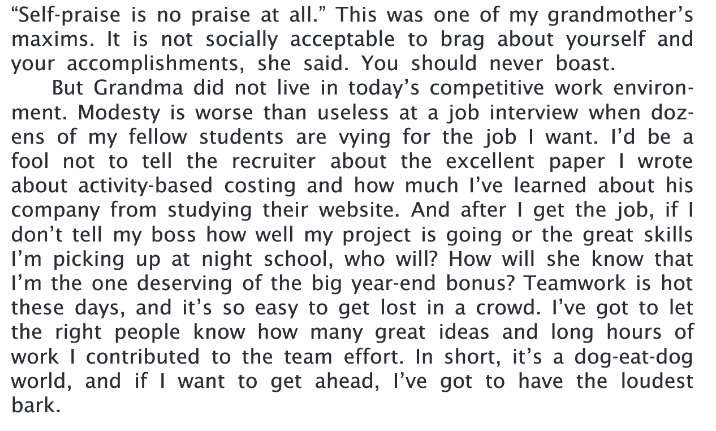
I think the claim is that in our current society, there is so much competition and to get ahead of others, we must have lots of self-praise.
Textbook says "Self-praise is necessary for career advancement" or "Bragging leads to success at work"
Presenting claims
- Try to present the essence of what the author is saying in an accurate and concise manner
- Could be represented as
- a list of important concepts and a series of propositions about how the concepts are related
- Graphically as a diagram or drawing - a concept map for example
- Concept maps are very useful for studying and remembering ideas. Pictures help a lot, especially when meaningful
- Start with main ideas
- Structure varies, but can be made of boxes, arrows, pictorial representations, timelines, tree-branch, etc.
Writing effectively
- Put claim near beginning or end of report
- Use cue words such as in conclusion, therefore, the data shows that
- Be specific and make it make sense for the reader
- Use descriptive headings
Exercises
Exercise 2.1: Finding Claims
Read each passage and state the major claim being made by the author. Is it a contestable claim?
- So you want to be an accountant? Get three months of work experience as a cashier, six months in the accounts department of a medium-sized merchandising company, and three months as an assistant to a field auditor. It is my view that before entering university, every young person should be asked to spend a year working “hands-on” in her or his chosen discipline. The pre-university year would give them the opportunity to take a realistic and logical decision that this is what they really want to spend the rest their my life doing. No vicarious experience here — only hard facts and living knowledge. As a result, sitting in class listening to a professor lecture makes a lot more sense because what is said is what you have experienced and what gave you satisfaction. Both of my sons went that course; today, they are both on the top of the heap in their respective professions. By effectively mixing the theory with the practical, you will be returning to the world of work as a graduate who can be productive almost immediately. And after all, productivity is what education is all about. It is a socializing phenomenon for preparing us to be good citizens — producing wealth, paying taxes, voting wisely, improving our society, and living a good life
- The claim is: Prior to attending university, it should be mandatory for students to have a year of related work-experience.
- Professor Michael Howe of Exeter University in England has done substantive research on excellent performance in sport and in the arts. As a result of his studies, he and his colleagues believe that the notion of innate ability — what we call talent — is a myth. Rather, success is determined by training, motivation, and, above all, long hours of practice. Professor Howe studied expert swimmers, tennis players, violinists, and so on and found that thousands of hours of devoted practice were required for excellent performance, even among so-called “child prodigies”. Many outstanding performers were not seen as particularly gifted as children, but training opportunities, encouragement, and hard work paid off for them over time. The myth of talent persists only because we do not normally observe the lengthy, gruelling practice sessions engaged in by most experts. Professor Howe’s findings have important lessons for teachers, parents, and students alike.
- Claim: In order to be successful, you must stay motivated and train long hours.
- Put six pots of jam on a table and offer people a $1 coupon toward buying jam. Some people will stop, try, and buy the jam. But then put 24 pots of jam on the table and offer the same $1 coupon. Many more people will stop, of course, but, surprising to say, only one-tenth as many people will buy the jam. Why? Too much choice, according to the research of Sheena Igenyar, a professor at the Columbia Business School in New York. In everyday life in Western societies, people are faced with an overwhelming variety of choices. Whether you are choosing a box of cereal, a career, music to listen to, a travel destination, or even a mate, it may be helpful to realize that too much choice can be crippling. In fact, when limits are placed on our choices, these limits free us to act.
- Claim: The abundance of choice leads us to not act
- "Early to bed and early to rise, makes a man healthy, wealthy and wise.” Ben Franklin popularized this rhyme almost 300 years ago, and it’s still true today. Getting a head start on the workday can really put you ahead of the other guy. You will have time to have a good breakfast, plan your day’s activities, and maybe even get in a little morning exercise. You’ll certainly impress your boss when you arrive at work before he or she does. Recent studies show that morning people are more conscientious, less stressed, and more productive than later risers. So if you want to be successful, don’t burn the midnight oil, and then sleep in the next morning.
- Claim: If you want to be successful, wake up early
- Testing consumer products on animals must stop. Animal tests are not accurate; data from them cannot be extrapolated to human beings. There are enormous differences in metabolism and physiology among rats, rabbits, dogs, pigs, and human beings, so product tests on animals do not prove that the products are safe for human use. Every year 100,000 people die from taking prescription drugs that have been found to be safe in animal tests. Most cosmetic companies no longer conduct animal testing. Scientists can now create artificial skin, protein membranes, and even artificial brains to test the irritancy or toxicity of substances. Companies no longer have to kill or maim defenceless animals to conduct their research. Corporations that continue to use animal tests must be persuaded — by concerned citizens and, ultimately, by government legislation — to find alternate means of testing their products.
- Claim: Businesses should not be allowed to use animal testing on their human products
- Everyone should spend a few days each month practising digital detox. Leave your smartphone at home, disconnect the GPS, disengage from social media and email, remove your ear buds. People are so embedded in these technologies that their impact goes practically unnoticed. Scholars suggest that occasional withdrawal from our digital devices can bring us to a deeper understanding of how they affect our choices and our relationships. We free ourselves from the insistent siren call of consumerism and our compulsive attachment to frivolous content, and this allows us to reconnect with our immediate environment and to evaluate how the social pressures of the digital world may be affecting our daily lives.
- Practicing freeing yourself from technology will lead you to a more fulfilled life
Exercise 2.2: Contestable and unproblematic claims
Is each one contestable or not?
- Employment equity legislation has made salary discrimination a thing of the past.
- contestable
- Military veterans often have a difficult time reintegrating into civilian society.
- unproblematic
- A brain drain occurs when large numbers of skilled, college-educated workers emigrate from a country.
- unproblematic
- The use of cross-functional teams increases the success rate of new product innovations.
- contestable
- Buy shares in late December, sell in early spring, and you will do well in the stock market.
- contestable
- In June 2016, a referendum labelled “Brexit” led to a decision that the United Kingdom would leave the European Union.
- unproblematic
- Rewards motivate employees.
- unproblematic
- In economics, equilibrium exists when supply equals demand.
- unproblematic
- The glass-ceiling syndrome is a primary reason why women leave large organizations and start their own businesses.
- contestable
- Pollution from industrial waste has been a leading factor in environ mental degradation and decline.
- contestable