Chapter 1 - Intro - Notes
Intro
- What is critical thinking?
- Asking questions, examining assumptions, weighing the validity of arguments when reading, thinking, learning
- Utilize strategies to effectively make intelligent decisions
- Critical thinkers introspect about their own thinking processes, they work on knowing their biases, listening to others ideas and becoming informed enough to form their own opinions and make judgements
- The word "critical" comes from the Greek work kritikos - meaning questions, analyze, or make sense of something
- Trying to assess the truth of a given matter
Critical thinking about business
- Information is constantly thrown at us
- Top 3 books in North America published in the past three decades:
- Barbarians at the Gate: The Fall of RJR Nabisco by Bryan Burrough and John Helyar
- About corporate takeover of tobacco and food processing company
- The 7 Habits of Highly Effective People: Powerful Lesson in Personal Change by Stephen Covey
- Self-help book that people have found inspiring and applicable everywhere in their lives
- The E Myth Revisited: Why Most Businesses Don't Work and What to Do bout It by Michael E. Gerber
- Goes on and on and on
- Barbarians at the Gate: The Fall of RJR Nabisco by Bryan Burrough and John Helyar
Buyer beware
- We count on experts A LOT
- how to get a job, how to invest for retirement, how to deal with difficult people at work, etc.
- Bestselling books can just be a marketing thing, not necessarily a indicator of worthiness of the CONTENTS of the book
- Experts disagree with each other, and so we must be critical thinkers when it comes to advice from experts
- We are constantly fed information and things we already believe
- If I believe genetically modified (GM) foods are unsafe to eat, my friends will send me links to it, social media apps will push it
- We have a clear, yet unconscious, preference for information that supports our original beliefs - this is confirmation bias
- False information is abundant and spreads WILDLY!
- Business executives frequently monitor the online information about their brands, logos, etc. to combat this
The sponge
- Used to demonstrate a procedure we should avoid when reading or listening to others
- Sponges just sit there and soak up liquid - readers who act like this simply soak up information
Dimensions of critical thinking
- Critical thinking process can be divided into 5 major parts
- First, it's purposeful. Using thinking strategies, we are trying to settle a problem, develop an answer to a question, or decide on appropriate action
- It benefits us to ensure our thinking is directed at a significant and useful purpose and that we state clearly the issue at hand
- This is in Chapter 2, focusing on the central claims of business texts.
- Second dimension looks at quality of data and reasons that are available to support claims
- Are sufficient reasons provided? Is the information accurate? etc.
- These questions examine the quality of the evidence (Chapter 3)
- Third dimension is considering that claims and evidence selected to support them are powerfully shaped by basic assumptions
- Can we identify the POVs that underlie the stated beliefs and evaluate strengths/weaknesses
- Chapter 4 handles considering our own underlying assumptions and values
- Fourth dimension focuses on interferences about cause and effect
- There's lots of "If you do X in your firm, Y will be the result" but in (Ch. 5) we'll see these are causal claims.
- Fifth dimension is to consider the way in which ideas are expressed in order to persuade the audience.
- Consider the way in which key concepts are presented, how contradictory evidence is managed, how words can sway judgements, etc.
- Chapter 6 focuses on these techniques of persuation
- First, it's purposeful. Using thinking strategies, we are trying to settle a problem, develop an answer to a question, or decide on appropriate action
An example
About the underground economy:
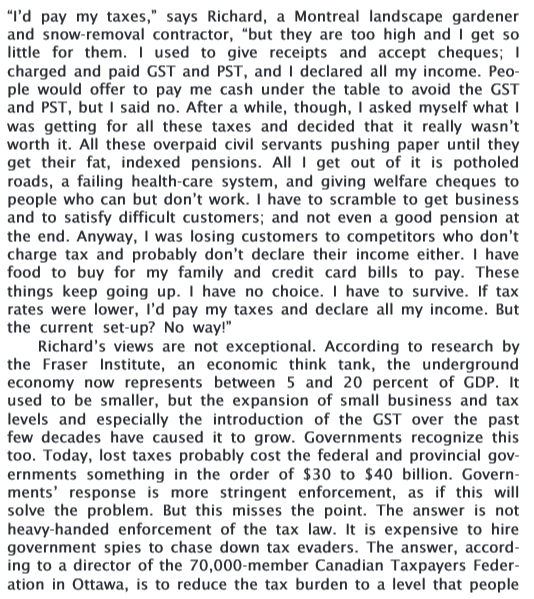

Questions to consider:
- How relevant are Richard's household expenses to the argument that he should not pay taxes?
- Does the anecdote about Richard affect the persuasiveness of the author's conclusion?
- Is tax reduction better than enforcement? Will compliance really increase if taxes are reduced?
- What is the effect of phrases such as "potholed roads", "fat, indexed pensions", "government spies"?
- Why does the author say that more stringent enforcement "misses the point"?
- Who are the people likely to join the Canadian Taxpayers Federation? What is the effect of noting there are 70,000 members?
- What is the position of the author of this piece? In fact, who is the author and what is their background?
- In my opinion, what are the reasons people evade taxes? Which, if any, are morally justified?
- Does it matter if they're morally justified? Who gets to decide that?
Critical thinking and effective communication
- Critical thinking helps to improve your own arguments when you write or speak
- Be able to avoid fallacies in reasoning, explore your own underlying assumptions, deal with evidence that opposes your views