BUS 121W - Week 3
Class 5 - Jan. 20, 2026 & Class 6 - Jan. 22, 2026
Premises & logical reasoning and evidence!
Premises = Key Points that support the claim
Why should we accept a claim?
- Premises are high level key points that give rationale
Example:
- Claim: Smartfood is the best study snack
- Premise 1: It is inexpensive
- Evidence: One portion costs $2.96
- Premise 2: It is convenient
- Evidence: There are 8 stores that sell
- Premise 3: It is tasty
- Evidence:
- Premise 1: It is inexpensive
Logical Reasoning - Assessing if an argument VALID
- Valid reasoning = correctly applying deductive reasoning in drawing out the logical conclusion of your premises
- Deductive reasoning = spelling out whatever conclusion follows logically from your premises, without reference to any external information
- It is obvious that the conclusion we're leading to follows from a structure
- Like a proof!
- Only considers the structure of the form of the argument, NOT the content
- Examples:
- Premise 1: All business students are competitive
- Premise 2: I am a business student
- Conclusion: I am competitive
Relevancy matters! It must follow logically and must be very relevant
Bad example (INVALID STRUCTURE):
Premise 1: Automated speed cameras regularly lead to reductions in average driving speeds of 9 km/hr.
Premise 2: Automated speed cameras improve driving behavior
Premise 3: Automated speed cameras allow police officers to focus their time on critical safety duties that require human involvement.
Conclusion: Automated speed cameras are not a cash grab and should be reinstated
Each premise cannot overlap and they each must be relevant.
Logical Reasoning - Assessing if argument is SOUND
- Sound argument - a deductive argument is both valid and has true premises, meaning it's conclusion must also be true
- Unsound argument - an argument that does not meet the standard of soundness, either because it is invalid or because at least one of its premises is untrue.
- Evaluate evidence to assess if premises are true
Evidence
- Statements that supports premises and answers why the claim should be accepted
- Examples:
- Statistics
- Details of past events
- Anecdotes
- Previously established/accepted claims
- Opinion vs. argument
- Differs from person to person
- Beware of fallacies:
- "erroneous, but frequently persuasive, ways of being led from a reason or circumstance to a conclusion"
Assessing Quality of Evidence
| Criterion | Examples | How? |
|---|---|---|
| Accuracy | Must support instead of undermine or negate claim | - Draw on existing experience with the subject - Do your own research - Use proxies - are there errors? - are sources missing (always look at citations!) |
| Precision | Appropriately precise - not over, not under | - Use numbers for quantitative evidence (this is the easiest one) - They must be contextually precise - Use direct quotations for qualitative evidence - Avoid ambiguous and abstract words that describe measurable evidence or qualitative evidence |
| Sufficiency | - Is there enough evidence? - In general, a single piece of data is not enough - How much is enough then? It depends - Varies with importance of claim and potential damage if claim is accepted - Short op-ed: 3 - Research paper: 40 companies - Medical study: 1,000+ patients - It's more than just numbers though! Beware of the fallacy of hasty generalization |
Does your argument include enough evidence to validly and soundly support your claim? |
| Representativeness | Variety of sources should match the variety in the population relevant to the claim - Fair sample is the most credible Beware of the fallacy of hasty generalization |
Take the time and care to comprehensively consider who is impacted/involved |
| Authority | Does this person actually know what they're talking about Special training and/or professional credentials - Scholars (especially when their evidence is in peer-reviewed journals) - Experience Contextual Vested Interest - What the source may gain from their argument being accepted - Politicians gain votes, companies gain customers, consultants gain clients |
BEWARE: fallacy of appeal to false authority - like when you see a professional athlete on an unrelated commercial - trusting someone just because they're famous, not because they're qualified BEWARE: fallacy of argumentum ad populum - "everyone believes this, so it must be true" - Popularity is not the same as correctness |
| Clarity of Expression | - Evidence can be easily misinterpreted - Interpret the data for the reader and state its significance explicitly |
- Share your insights gained through analysis - Add meaning for the reader |
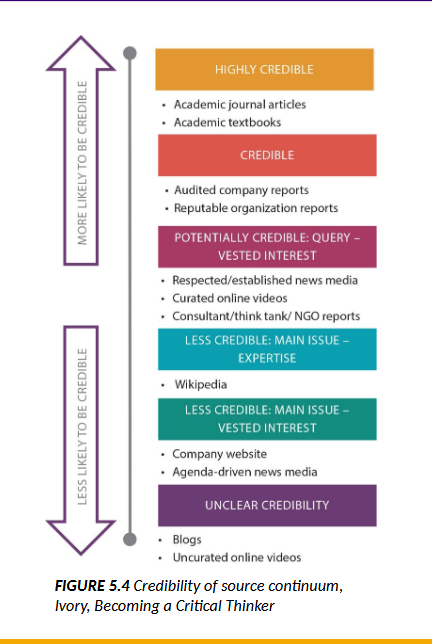
Helpful tools to consider credentials and vested interest
- This scale guides the level of questioning and skepticism we should apply to different types of sources
Additional considerations when evaluating reasoning & evidence
- Many claims and sub-claims are casual, proposing an if-then relationship
- In casual claims or sub-claims, we must examine whether causation is indeed probable or if correlation is more likely
- CORRELATION is NOT CAUSATION
- Correlation is when two things happen together, but one doesn't necessarily cause the other
- "When A changes, B also changes"
- Example: Ice cream sales ↑ and drowning incidents ↑
- They’re correlated. Why? Hot weather causes both
- Causation is when one thing directly causes the other
- "When A causes B"
- Example: Smoking leads to lung cancer
Common fallacies to watch for:
| Fallacy | Example |
|---|---|
| Appeal to irrelevant/false authority | Snoop Dogg & anti-virus software |
| Appeal to popularity (Argumentum ad populum) | Open concept office plans |
| Appeal to pity (argumentum ad misericordiam) | Employee excuses résumé lies by describing personal hardships |
| Ad hominem (attacking person instead of argument) | Elon Musk attacks CEO's knowledge instead of answering the question |
| Appeal to fear/threats (scare tactics) | Boss threatens employee with job loss |
| Straw man | Person B exaggerates Person A's position to make it easier to attack |