BUS 121W - Week 2
Class 3 - Jan. 13, 2026
Characteristics of LLMs
- Very good at predicting text - but this is why it can hallucinate
- Try to write like humans
- They aren't humans!!!
ABCs of Gen AI Prompting !
- Aim & Audience
- Define the AI's role and goal and clarify who the AI is addressing
- Background & Boundaries
- Give context and set constraints to focus the answer
- Clarity & Calls to Action
- Use direct, specific language that tells the AI what output you need and what steps it needs to follow
Be the Human
- Check shit and make sure it's accurate
- Tell the LLM what it's doing good and what it needs to improve
- We are leading the interaction, actively engage and integrate our own thinking
- Respect copyright and intellectual property
Class 4 - Jan. 15, 2026
What is critical thinking?
- Definition: An approach to reading, thinking, and learning that involves asking questions, examining our assumptions, and weighing the validity of arguments...a set of strategies that we will use as we determine whether or not to believe what we read or hear
- Critical: question, analyze, make sense of something
- Argument: an attempt to persuade someone through reasoning to accept a particular conclusion
Don't We know how to critical think?
- We are creatures first, and thinkers second, and rationally self-critical thinkers last of all
- We have evolved to do just enough critical thinking to survive
- Humans are pattern-seeking, story-telling animals
Key Dimensions of Critical Thinking
| Dimension | Overview | Example |
|---|---|---|
| Argument | An attempt to persuade someone through reasoning to accept a particular conclusion | |
| Claim | Conclusion/idea that author is trying to persuade you to accept - more high-level |
Smartfood is the best study snack. |
| Premise(s) & Logical Reasoning | - Support to back up the author's claim - Answers 'why' the claim should be accepted - Contribute to a valid and sound argument - Usually able to follow one after another |
It is inexpensive, convenient, and tasty. |
| Evidence | Information that supports the premise(s) | Cost is $2.96, available in 8 stores within 1 km, won snack food taste contest |
| Underlying Assumptions | - Author's views of how the world works now and how the world should work - Influences what evidence is used to support the claim |
Reality = reader's food budget is similar, home is close to stores that stock Smartfood, taste buds are similar Value = people should snack while studying |
| Techniques of Persuasion | Using rhetoric and methods to make the claim more likely to be accepted - Objection & rebuttal - Logos, ethos & pathos |
While some argue that eating Smartfood is messy, that concern can be easily addressed by using a napkin. The smart choice for smart students is Smartfood. |
Key Characteristics of Critical Thinking
- Self-aware
- Curious
- Try new approaches
- Seek out new viewpoints
- Open to new perspectives
- Independence
- Interdependence and independence in a way
- Listen to ideas of others and learn from others
- Not just totally going on their own
- They make their own decisions and judgements about topics
- Being a healthy skeptic - "it doesn't mean you believe everything all the time and it doesn't mean you don't believe anything ever. it means you make judgements about when to believe something and when to not"
- You're trying to find a good balance
Key Characteristics of Uncritical Thinking?
- Follower (a sponge): blindly accept all arguments, ignoring reasoning and assuming evidence presented is reliable
- Easily change their minds
- Cynic: Rejects all arguments, assume all reasoning is flawed and all evidence presented is biased or false
- Even when there's good reasoning, they discount everything presented to them
How does critical thinking look in the workplace?
- Critical thinking isn't about having all the answers, it's about asking better questions
- Are we solving the symptom or the cause?
- What's missing from this picture?
- Who benefits if we believe this?
- Shareholders vs Customers
- Where else have we seen this pattern?
- What evidence would change our minds?
- Does the conclusion follow, or are we skipping steps?
- What's the simplest test we could run?
Why is critical thinking important?
- Manage information overload
- Improve our understanding of the world
- Improve our performance in business world
- Evaluate implications of business values/strategies in other spheres
- Manage 'age of the expert'
- Everyone has their quick, cheap and easy expert to get their platform to you
- Guard against confirmation bias *
- Mange increasing misinformation, disinformation and polarization
- Misinformation is false information but the person sharing it believes it's true
- Disinformation is false information but the person sharing it knows it is false
- Retain our unique abilities of being human
- Act as responsible, active, and effective community members and global citizens
Confirmation bias
- The universal human tendency to use new information in order to confirm what existing beliefs, rather than to improve or clarify your understanding about a topic
- Example: If you believe something, so you click the first google link when you search a topic
- Seeking evidence that supports what we believe and avoiding or ignoring evidence that goes against it
- How to fix it: Actively seek out opposing viewpoints - don't let algorithms choose your inputs
- Confirmation bias is one of many cognitive biases
- RE-search implies searching more than once
- Doing multiple searches "research"
How do you improve critical thinking?
There are 6 lessons on how to improve it:
- Confirmation bias (already talked about previously)
- Accept that it's hard and takes time to develop
- We aren't going to have this mastered in 12 weeks, as it's a hard thing to learn
- It's a higher-order skill
- It's kind of like Ballet - humans learned to dance on their toes, it's not a normal thing humans do
- Practice it explicitly in its own right (SLOWLY*)
- You can't just pick it up by osmosis
- Deliberate practice
- Practice for transfer
- Not just in BU121, in social lives, non-academic world, everywhere
- Learn a balanced, practical amount of theory
- To do well, it helps to understand terminology and frameworks
- Allows mentors and coaches to talk to you about the pieces of the frameworks you're missing
- Analogy - baking bread
- The yeast is theory
- Flour and water is practice
- Map it out
- The only way of learning critical thinking is not just by watching other people and learning from them
- Make thinking visible - we are very visual learners
How do you practice critical thinking?
- You must be SLOW
- Critical thinking is a system 2 process which is deliberate, effortful, and self-controlled
- Make conscious choices, concentrate and reasoning
- This is in contrast to System 1
- It is very automatic, involuntary, unfiltered
- Confirms existing models and uses biases
- We need both to survive **
How do the thinking systems work together?
- System 2 adopts suggestion of System 1 with little or no modification quite effectively
- This can lead to WYSIATI
- "What You See Is All There Is"
- We form a judgement based on what we know, without pausing to consider whether we actually know enough to justify such a judgement
- We must SLOW down and use System 2 when System 1:
- Runs into difficulty
- Is surprised (an event violates the model that System 1 maintains)
- Detects that an error is about to be made
- Multi-tasking WARNING
What is an argument map?
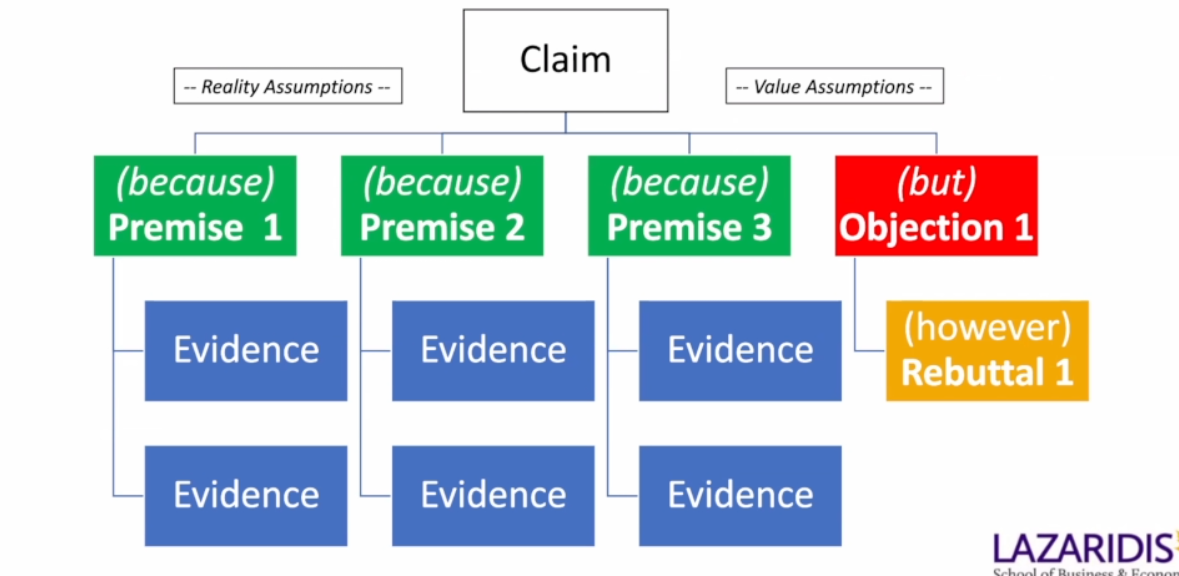
- There are many different templates, but in BU121, this is what they use
- Why are they effective?
- Make reasoning more understandable and visible
- Allows important issues/components to be more easily identified
- Easier to follow multi-layered arguments
- Allows peers/teachers to give more rapid and targeted feedback
What do we need to know about claims?
What is a contestable claim?
- A conclusion reached through judgement that an author is trying to persuade you to accept
- Can someone take a different position on this issue?
- Must be able to take a position on the issue
- NOT an example, definition, or statistic
What are characteristics of an uncontested claim? - Observable experience that matches our lived experience
- An author's subjective preference
- "My favourite breakfast food is granola"
- Facts that are technical or mathematical
is irrational
- Facts that are independent of interpretation *
- The population of Toronto is greater than the population of Waterloo
- Events that occurred *
- Federal government changed the EV mandates in 2025
- Statements that many experts agree on *
- *unless new information alters them
Using Gen AI responsibly as a Learning Tutor
Aim/Audience: I am a first-year university student studying critical thinking. You are my friendly and professional learning tutor.
Background: I have learned that a contestable claim is a conclusion reached through judgement that an author persuades others to accept. An example of a contestable claim is "The government of Canada should be more strict on immigration policies".
Uncontested claims are different from contestable claims because they represent lived experiences/observations, or personal preferences, or facts independent of interpretation, or past events, or technical or mathematical calculations, or conclusions that are agreed upon among a wide range of experts. An example of an uncontested claim is "My favourite sport is basketball".
Boundaries/Call to Action: To help me practice my understanding of claims, please provide me with 10 claims about hockey. Include a mix of contestable and uncontestable claims. Ask me to correctly categorize each claim and explain why it is either contestable or uncontestable. Respond once I have categorized all 10 claims and state whether I am correct and why. Require me to do the
CLICK ME FOR GEN AI TUTOR